What is Tai Chi?
Historically, Tai Chi Chuan is part of an ancient Chinese art that has been used for thousands of years based on Taoism and Chinese medicine. Known simply as ‘tai chi’ in our western world, it can be translated into English as greatest or supreme, being synonymous with ‘largest’ rather than with ‘best’ (T’ai) and ultimate (Chi). Chuan meaning method or fist is the physical way in which the tai chi is manifested.
There are different ways of spelling ‘Tai Chi’ and ‘Qigong’ depending on which method of Romanisation is used or how the Chinese characters are written using a Western alphabet. The first main Romanisation method is Wade-Giles, spelling it Tai Chi Chuan and Chi Kung; the second Romanisation method is Pinyin, spelling it Taijiquan and Qigong. Most of us will recognise the spellings of Tai Chi but not Taijiquan, and Qigong but not Chi Kung.
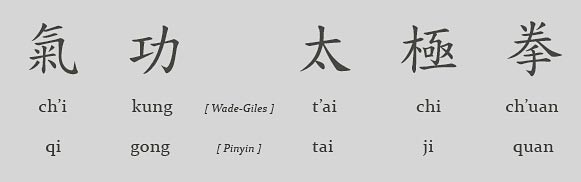
To the question, what is Tai Chi?
There can be many answers. Some of you might have the picture of Chinese people practising some movements in a park, usually early in the morning. To define tai chi in 20 words, ‘tai chi is best thought of as playing: playing with movement and breath, playing with energy and playing with consciousness’.
More comprehensively, tai chi is a holistic and uncompetitive practice which aims to harmonise the natural rhythm of the body through physical activity with those of the mind; it endorses these important aspects amongst others:
1
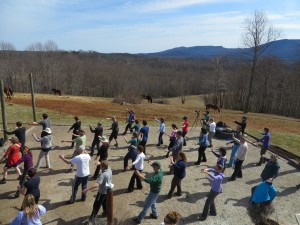
It is one of the best practices for long-term health, wellbeing and longevity; it will improve one’s immune system, digestive system, heart rate and circulation; it will increase one’s vitality, mobility, flexibility and enhance correct posture.
2
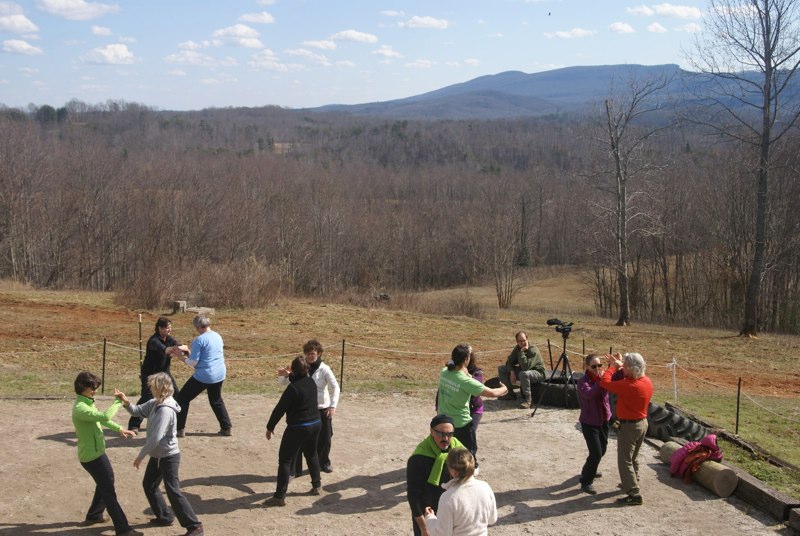
The hectic pace of modern living and lack of exercise leaves us tired and exhausted. The quiet and gentle nature of tai chi helps to overcome stress and its related problems, especially since it is uncompetitive. Tai chi will aid relaxation and calm the mind; it teaches patience and will improve one’s confidence, feeling of awkwardness, problems with established self-image as well as mental concentration. It encourages in our work of “converting the negative into the positive”: the more the release of negativity, the more the energies will be developed. [1] [1] Esther Hicks, The Law of Attraction: the Basics of the Teaching of Abraham, [Hay House: 2006],
p. 70
3
Tai chi is the ‘cleanest tool’ for finding out about ourselves. Irrespective of age, race, culture or religion, tai chi helps recognise the subtle energies of the mind and spirit in order to achieve stillness and clarity. It does so not by treating mind and body as separate parts, but as a single cohesive unit: strengthening one means strengthening the other.[2] It refreshes your mind and energises your body. It soothes your heart and enriches your soul.
[2] In Chinese, the mind is the ‘General’, the body its ‘soldiers’.
To sum up, tai chi is a set of principles which have been observed to be effective in their positive influence regarding life in all its expressions of movement and change. They have been handed down both orally and through the traditional writings of tai chi. They include an emphasis on relaxation of tension, both physical and mental, leading to the development of internal strength; a process of integration in which the mind and body become unified and an understanding that the key element with respect to any life success is the maintenance of the qualities of balance and harmony. Furthermore, tai chi is life, life itself; sometimes experienced in a subtle way, but most of the time tai chi simply lives with you, is in you. Once you are aware of it, it won’t leave you.
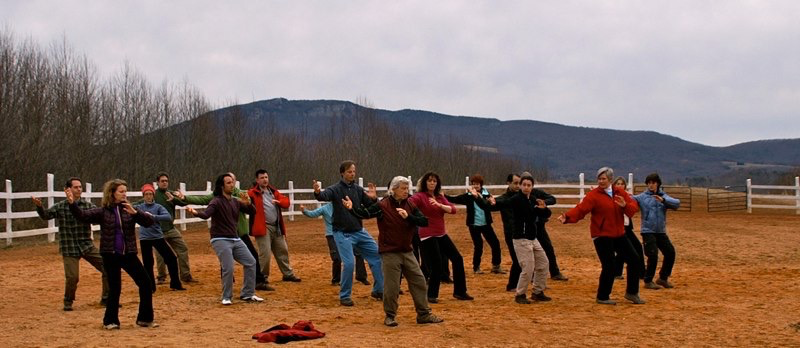
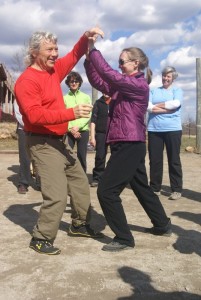
Practising the Form at Heavenly Way, North Carolina in February 2012